 Parallel
Parking: from luck to likelihood.
Change is coming. Parallel studies how every Montréal street fills and empties — hour by hour, sign by sign — and gives you one honest number before you drive: the odds of finding a spot.
Every street on this is a data point recomputing itself. Parallel will always give you the probability curve — live, all day, for every block in the city.
Ten seconds at the curb
How you'll use it.
Open the map
Your streets, each one shaded by its odds right now.
Read the odds
Green, orange or red for every block — scrub any hour to see the odds shift.
Park
Head for the green, let Parallel guide you in, and it'll remember where you left the car.
In tempo with the city
Every street has a rhythm. Parallel knows it.
No cameras, no crowd-sourcing, no wishful thinking. Parallel simply knows every block — when it fills, when it empties, how the rules reshape the day — and hands you one honest number: the probability you'll find a spot to leave your car.
- A rhythm per blockNo two street segments keep the same beat. Parallel knows each one personally.
- Time-awareHour, weekday, season — the odds at 14h on a Tuesday are not the odds at 18h on a Friday.
- Rules move the oddsStreet sweeping, snow bans and permit zones aren't footnotes. The odds shift the moment the rules do.
- Honest probabilitiesParallel never pretends to see the curb. It tells you the odds — and the odds are usually enough.
P(open spot) · Avenue Laurier · Tuesday — the crater is street sweeping, the evening slide is everyone coming home.
What you get on the street
Built for how Montréal actually parks.
A probability for every block, a best time for every errand, and every confusing sign already read for you.
Odds on the map
Every block face, shaded by its probability right now.
- Street-level probability heatmap
- Tap any block for its odds and rules
- Green means go, red means full
The best time to arrive
Sometimes leaving twenty minutes later doubles your odds.
- Availability curves for every street
- Spot the windows right after street cleaning
- Plan around the evening crunch
Signs, already read
The whole pole, decoded into one plain answer.
- Street-sweeping windows
- Snow-removal bans & tow zones
- Residents-only & vignette zones
Built for winter
Montréal parking has seasons. Parallel knows every one of them.
- Snow-ban aware predictions
- Festival summers & moving day
- Weekday vs weekend rhythms
Check before you leave
The odds at your destination, from your couch.
- Search any address in the city
- Odds for when you'll arrive
- Know before you go
- Glanceable on your Home Screen & Apple Watch
Made in Montréal
Built by experience who parallel parks all year long.
- Borough by borough coverage
- Bilingual signs, bilingual app
- Local rules, local quirks
Real science, humming under the hood.
Under the map is something that knows every block in the city. It doesn't guess and it doesn't promise — it estimates, carefully and honestly, and it gets sharper as the city teaches it more.
- Per-block granularity — every stretch of curb gets its own answer, not one citywide average.
- Every rule counts — sweeping schedules, snow operations and permits reshape the odds through the day.
- Seasonal by design — February and July don't play the same tune. Parallel knows both by heart.
- Probabilities, not promises — you get an honest number, and honest numbers win over time.
P( spot | ██████████ )
The Parallel Method vs. hardware
The curb didn't need wiring. It needed reading.
Cities have spent a decade bolting hardware onto the pavement to solve this. Parallel needs none of it — nothing to install, nothing to break, and nothing watching you.
| Parallel | In-ground sensors & cameras | |
|---|---|---|
| Installation | None — live the day it's turned on | Drilled or mounted per spot, city permits required |
| Cost per block | $0 | Hundreds per spot, plus install crews |
| Time to citywide coverage | Immediate, borough by borough | Years, installed spot by spot |
| Maintenance | None | Batteries, cleaning, weatherproofing, repairs |
| Winter resilience | Unaffected | Snow, plows and road salt damage hardware |
| Privacy | No cameras, nothing recorded | Often camera-based, raises privacy concerns |
| What it gives you | A probability, honestly stated | A "reading" that's wrong the moment someone leaves |
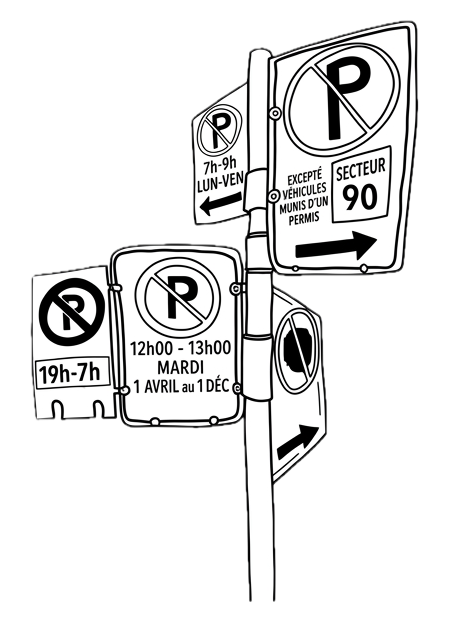
A whole pole of rules, folded into one answer — and into the odds.
Les panneaux, décodés
Signs written like riddles. Answers written in plain words.
A Montréal parking pole can stack four rules with three exceptions in two languages. Parallel reads the whole pole for you — sweeping windows, snow routes, permits, tow zones — and tells you one thing: can you park here, and until when.
- One plain answer"OK until 21h, 2h max" — not a logic puzzle at the curb in minus twenty.
- Snow ops includedWhen the orange signs go up and the tow trucks roll, Parallel knows which side of the street to be on.
- Rules feed the oddsA block that clears for sweeping at 11h is a block full of fresh spots at 11h05. Parallel knows that too.
- Or scan it yourselfPoint your camera at any pole — or drop in a photo — and Parallel reads it on the spot.
Before you ask
Questions people actually have.
Is this AI?
No. Parallel doesn't use AI, cameras, or crowdsourced reports. The odds come from real, live data — recomputed around the clock, not generated or guessed.
How does Parallel actually know the odds?
That part we keep. What we'll tell you: no cameras, no crowdsourcing, nothing invented — just an honest number, recalculated constantly for every block in the city.
Does Parallel cover paid, residential, and business parking zones?
Yes — all of them. Metered spots, residential permit zones, business zones: if a rule is posted on the pole, Parallel already knows it.
What's the difference between the real-time odds and the on-street parking rules?
They're two different things working together. The odds — powered by the Parallel Method — tell you where you're most likely to find a spot, anywhere in the city, right now. The on-street parking rules tell you whether it's actually legal to park there, so you don't end up with a ticket.
How reliable are the posted on-street parking rules?
We pull rule data directly from the city. In practice, we've found it isn't always complete or current — but we include it anyway, because knowing where you're legally allowed to park matters. Always glance at the actual signs before you walk away, just to be sure. We're working to make this layer more accurate over time.
Does it work during winter and snow removal?
Yes — winter is built in from day one. Snow bans, sweeping schedules and permit zones all reshape the odds the moment the rules do.
Is my location tracked or stored?
No. Parallel uses your location only while the app is open, and it's never linked back to you. See our Privacy Policy for the full details.
Is the app free?
Yes. Parking belongs to everyone, and the core experience always will. We also offer a paid monthly tier — server and data costs aren't small, and paying members help keep Parallel free for everyone else.
When and where does Parallel launch?
Montréal, this August — borough by borough. Use the form below if you want to know the moment it's live.
Will there be a public API?
Yes — see the API section below. It's not live yet, but the odds it will serve already exist today.
Park like you know something.
Parallel launches in Montréal this August, borough by borough. Leave your email and we'll tell you the day it goes live near you.
Coming to the App Store — August 2026
For developers & partners
An API is coming.
The same odds the app shows, delivered straight into your systems — for fleet operators, navigation apps, and city planners. You get the number. The recipe stays ours.
- Per-block probability lookupsQuery any street segment for any time window and get the same number the app shows.
- Decoded sign dataStructured rules — sweeping, snow bans, permits — not photos of poles.
- Built for integrationFleet management, municipal dashboards, and third-party navigation apps.
- Not AI — real-time dataThe odds are recomputed around the clock from live numbers. Nothing generated, nothing imagined.
curl https://api.parallelparking.info/v1/probability \
  -G \
  -d street="avenue-laurier-o" \
  -d segment=4 \
  -d at="2026-07-08T18:00:00-04:00"

{
  "street": "Avenue Laurier O.",
  "segment": 4,
  "probability": 0.41,
  "as_of": "2026-07",
  "confidence": 0.86
}
Illustrative response — the API isn't live yet, but the number already exists, every hour, for every block.
Get in touch
Questions, feedback, or press?
Send a message and we'll get back to you.